
Nine Inch Nails, Cheeseheads, Terrible Towels: Why Aaron Rodgers and the Pittsburgh Steelers will NOT win a playoff game in 2026!!!
I should not be the one telling this story. But, since putting the pieces together, historical circumstance, intellectual curiosity and a sense of creeping dread regarding the outcome of Pittsburgh Steelers quarterback Aaron Rodgers’s next playoff game compels me to share this with the world.
In short, I have evidence that Rodgers’s playoff career may be predicted, connected in some way, to the songs of Nine Inch Nails’ 1999 double album The Fragile. My evidence leads me to predict that Rodgers and the Steelers will make it to the 2026-2027 playoffs, but will not win a playoff game. I know that this is an unbelievable claim, but scholars and cultural theorists from Theodore Adorno to Mark Fisher have discussed music and pop culture’s relation to different aspects of our lives—as both a mirror and a driver of social and political events. If art can play a role in societal and political events, why not assume it could do so in sports as well?
The Fragile was my favorite album for much of my adolescence. I bought the album in seventh grade on one of my cross-town bike trips to Hastings, a combination book shop, video rental, and music store. The album had a “parental advisory” sticker on the cover, but the 20-something stoner working the counter did not seem to care that they were selling an album with lyrics chock full of drug use, suicidal ideation, and general misanthropy to a 12 year old. While the album is uneven musically and overly simplistic lyrically, frontman Trent Reznor’s meticulous attention to detail regarding the album’s composition and recording was inspiring then, and still is today. At a time when my musical tastes could be described as “whatever every other white teenage boy in Montana is listening to,” The Fragile introduced me to the idea that an album of individual pop songs could be more than the sum of its parts, a true 23-track album, and that compositions do not necessarily need to follow a verse-chorus-verse-chorus-bridge-chorus-outro structure to be “songs.”
My interest in the numerological connection between Rodgers and The Fragile began in late March of 2020, when I flew back from Washington, DC to Montana. My short-term lease was expiring, and I did not want to spend the rest of the COVID-19 pandemic in a densely populated city. Ronald Reagan International Airport was a veritable ghost-town, with no more than 10 other travelers in the entire airport. Seeing a normally crowded liminal space so quiet at a time when people were dying horrible deaths from a communicable disease was eerie. The airport, a symbol of economic and cultural globalization became a de facto museum, a hulking monument to the temporary nature of our current societal ordering and its resulting ordering of our thoughts, expectations, and epistemologies. Sand castles back to sand in time.
In March 2020, many parts of the world were shutting down. Images of empty streets, from Times Square in New York to Champs-Elysses Avenue in Paris, to the beachfront of Miami. The most striking image for me personally was the Kaaba standing in the empty Grand Mosque at Mecca in Saudi Arabia as people were banned from visiting religious sites.
Time passed. On April 26, 2020, the Green Bay Packers drafted Rodgers’s heir apparent, Jordan Love. I remember watching the live broadcast being absolutely shocked at the pick. Rodgers was a two-time MVP, an eight-time Pro-Bowler, and a Super Bowl champion. Rodgers himself admitted that he was shocked by the pick. Analysts at the time were also surprised by the pick. Many also noticed the symmetry between the beginning of Jordan Love’s career and Rodgers’ own career. Rodgers was drafted in the first round to succeed a future Pro Football Hall of Famer, Brett Favre, who would turn 36 during the upcoming season. Jordan Love was drafted in the first round to succeed a future Hall of Famer, Rodgers, who would turn 36 during the upcoming season.
Many would call this a coincidence, but I would call it a “paradigm shift.” At a time of deep uncertainty, when the President of the United States said bleach or UV light could treat COVID, and the Department of Labor reported that 26.5 million Americans had filed for unemployment benefits since the COVID lockdown began, the epistemological foundation of the sports world was shaking as well. A draft pick that initially makes very little logical sense, “make senses” from a more esoteric, numerological, maybe even conspiratorial perspective.
In April 2023, Rodgers’s career once again dovetailed with Brett Favre’s in a numerologically uncanny fashion. After 3 years of development on the bench, the Packers made way for Jordan Love by trading Rodgers to the New York Jets. Fifteen years earlier, the Packers made way for Rodgers after 3 years on the bench by trading Brett Favre to the Jets.
There are several more numerological aberrations in relation to Rodgers’ career that cannot be ignored. Rodgers played wearing the jersey number 12 for much of his career. He currently has 12 playoff wins in 22 starts. Including one playoff game from his time backing up Brett Favre, Rodgers has played in 23 playoff games. When you count the letters in “Aaron Rodgers, Wisconsin,” there are 23 letters. Nine Inch Nails’ The Fragile has 23 songs on its original 1999 release.
The number 23 has extreme significance in the numerology community, of which I am a member. I will not go too much into the details on this, but for those who want to learn more, I refer you to Jim Carrey’s 2007 authoritative documentary film on the subject. Given the obvious importance of numerology in Rodgers’ career, the most logical methodological course of action would be to compare Rodgers’ performance, the outcomes of those games, to the content of each song in The Fragile’s track listing.
What does it mean that Rodgers’s playoff career is The Fragile? How could one define and measure the connection between the two?
Tonality, time signature, tempo, lyrical content…the effects of each of these variables may be important. Yet, just as football is a team sport, and viewing Rodgers’s performances separate from the context of his teammates and opponents would be illogical, one should thusly not view each element of a musical composition in isolation. A single voice in a five-part harmony presented in isolation is only melody, fundamentally changed. The rhythm of a single guitar part gains meaning when viewed in context with the rhythm section, and so on. As a result, my analysis and comparison of The Fragile and Rodgers’ playoff career will use a holistic, kaleidoscopic lens.
One final question on methodology: does Rodgers’s first playoff game, in which he did not start or throw a pass in, “count” in this study? If it does, the 23 tracks of The Fragile match up with the 23 games Rodgers has played in the playoffs thus far. However, without him meaningfully participating, without starting, it was not really “his game”; it was Brett Favre’s. Additionally, Rodgers is returning for one final season—his 23rd season playing quarterback at the national level, if we include his two years at University of California, Berkeley— with the Pittsburgh Steelers. It is within the realm of possibility that he will start his 23rd playoff game. As a result, his first playoff game is excluded from this study to ensure ontological consistency. (Editor’s note: It would make your article much less exciting if one of the best songs on the album was linked to a game that Aaron Rodgers did not even play in.)
Therefore, we must consider the possibility that the 23rd song on The Fragile is a prediction for Rodgers’s 23th and final hypothetical playoff game. Once again, based on my independent research, I predict that Rodgers and the Pittsburgh Steelers will make the playoffs this season, but will not win a playoff game. him in playing a game numerologically associated with the song titled “Ripe, With Decay.”
I will be presenting my findings on this site between now and the beginning of the 2026-2027 NFL Playoffs. So, without further ado, Here are my results for the first 5 tracks on the album, covering Rodgers’s performances in the 2009-2010 and 2010-2011 NFL playoffs.
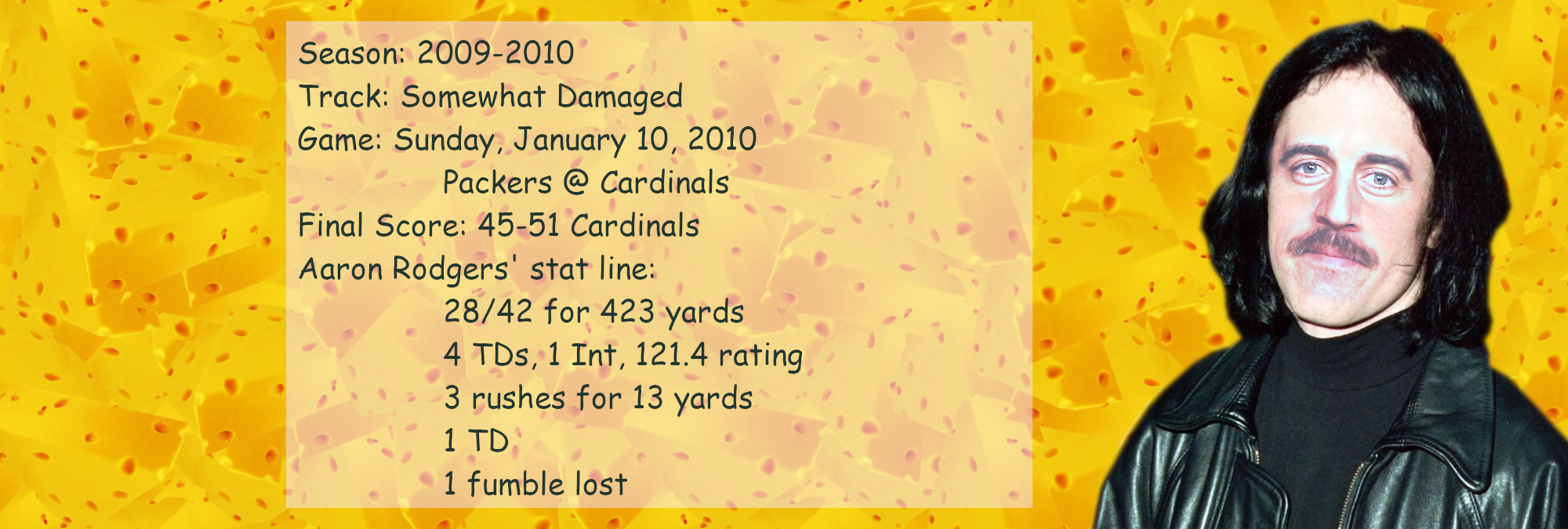
The Fragile opens with the slow-burning “Somewhat Damaged.”
Centered around a chromatic 3/4 ostinato, the song morphs from its relatively subdued (yet uneasy) first verse into cacophony. For Nine Inch Nails fans hearing the song upon its initial release in 1999, it signaled that The Fragile would further elaborate on the lyrical themes and sonic palette of its predecessor, 1994’s The Downward Spiral. It also shows that The Fragile will be a much more cinematic and atmospheric listening experience. It is one of the more immediately impactful songs on the album, and while it was not released as a single, remains a fan favorite. (For example, the Detroit-based punk rock band The Armed has been performing covers of it on recent tours.)
For contemporary listeners, and specifically for readers of this article, the song’s emotional impact stems from its connection to Aaron Rodgers’s whirlwind first playoff start. The Packers had defeated the Cardinals the previous week—which, even though the Cardinals rested Kurt Warner after the 1st quarter, still imbued the Packers with a sense of confidence entering the game. While the game was a loss for the Packers and Rodgers, it did much to remove the shadow Brett Favre’s legacy had cast over Rodgers’s play up until that point. Rodgers proved that he could indeed match up against other elite quarterbacks in offensive shootouts—the 96 combined points scored remain an NFL playoff record. Despite the fact that two elite quarterbacks—Rodgers and future Pro Football Hall of Famer Kurt Warner—were starting, it was not a given that the game would be so high-scoring, as the Packers’ fielded the league’s second-best defense of the 2009 regular season, led by 2009 Defensive Player of the Year Charles Woodson.
Sadly for Rodgers and Packers fans, the game also hinted at a truth that would plague Rodgers throughout his career: that regular-season greatness does not always translate into postseason success. As a result, his legacy is somewhat damaged by inconsistent playoff success.
As mentioned above, “Somewhat Damaged” starts with a chromatic 3/4 ostinato, hammered by a chorus of detuned guitars and ukulele. Percussive samples (including a saw) and dissonant synths are gradually layered on top as the first section progresses. A sense of creeping dread is established by the time Trent Reznor’s vocals enter with the softly spoken lines,
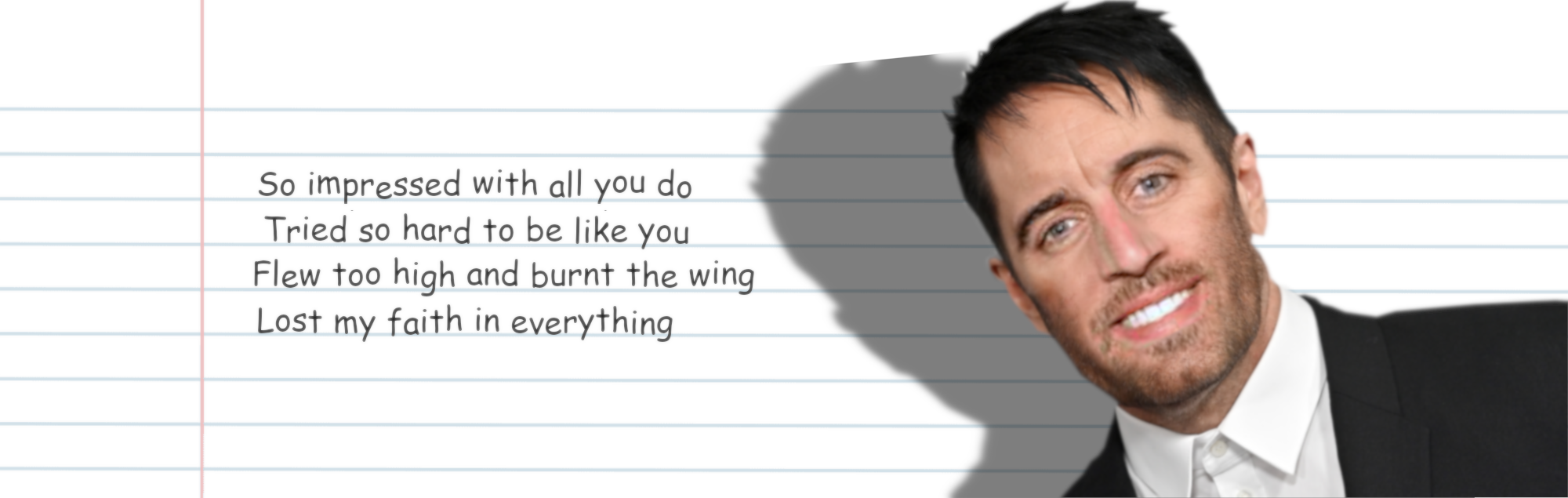
The first section of the song mirrors what we can imagine Rodgers’ internal monologue was during the first quarter of the game, in which the Packers offense gave away the ball twice, leading to a 0-17 deficit. If we interpret the lyrics in this light, the “you” in the lyrics could be Brett Favre; Rodgers wanted to emulate Favre’s success and seize the opportunity to quiet incessant chatter from Packers fans who were still disgruntled by the Brett Favre trade. After making it to the Pro Bowl in the regular season, 15 minutes into his first playoff game, it indeed appeared as if Rodgers “flew too high and burnt the wing.”
In the second stanza of “Somewhat Damaged,” the arrangement becomes more loud, claustrophobic, with static-y synths and additional guitar layers building tension. At this point, Reznor’s delivery is more aggressive—while still restrained and melodic, compared to the later half of the song—as he shouts:
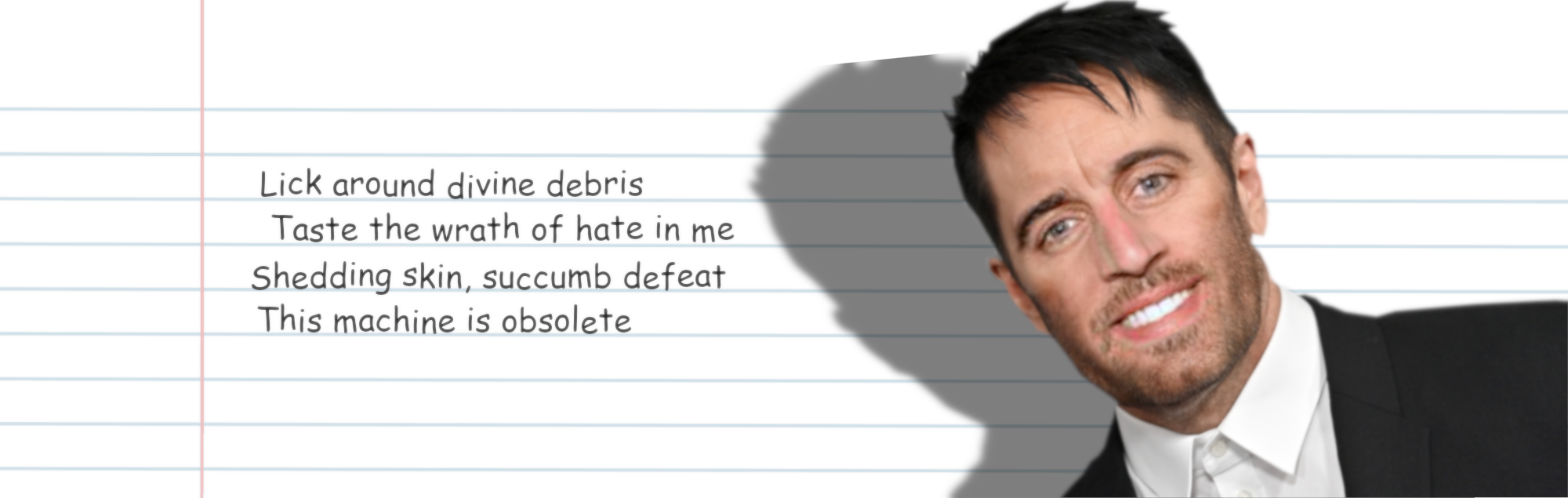
This mirrors the Packers’s play in the second quarter: the offense finally got on the board with a one-yard touchdown run from Rodgers and a field goal by Mason Crosby. Yet, the quarter closed with the Packers down 10-24. Like Reznor’s narrator in “Somewhat Damaged,” the Packers were becoming more desperate, and were metaphorically “heating up” on offense in the same way Reznor’s vocal performance becomes more intense in “Somewhat Damaged.” Yet, in the face of a 14-point deficit going into halftime, the machine of the Packers’s vaunted defense and burgeoning elite quarterback feel obsolete.
By its two-minute mark, “Somewhat Damaged’s” central ¾ ostinato is carried by heavily distorted guitars playing drop-D power chords. At this point in the song, Reznor’s screams are clipping and less controlled. Just as the composition becomes more unrestrained and relentless in the beginning of its second half, the Packers offense began to find its rhythm, scoring two touchdowns in the third quarter. While the Packers were still behind by multiple scores, by the end of the third quarter, it seemed as if they may have a chance to stage a comeback. In the same way that as Reznor screams that he is “broken, bruised, forgotten, sore, too fucked up to care anymore,” the Packers continue to play hard in spite of the deficit.
In the fourth quarter, Rodgers led the Packers to three touchdown drives, tying the game with less than two minutes left. At this point in the game, momentum seemed to clearly be on the Packers’s side—if they got the ball first in overtime, they would score and win. At this point in the game, Rodgers appeared calm, collected, and in control. In the same way, “Somewhat Damaged” quiets down for much of its final section; most of the oppressive synths and heavy guitars drop out, Reznor’s vocal delivery becomes more controlled. Yet, the percussion in this section is in 4/4, clashing with the ¾ ostinato (which, at this point in the song, is less of the listeners’ focus—the vocals and drums are driving the composition forward). At approximately 3:39, a prominent synthesizer playing the ¾ ostinato enters, making the 3 over 4 polymeter more noticeable and jarring. At this moment, Reznor asks:
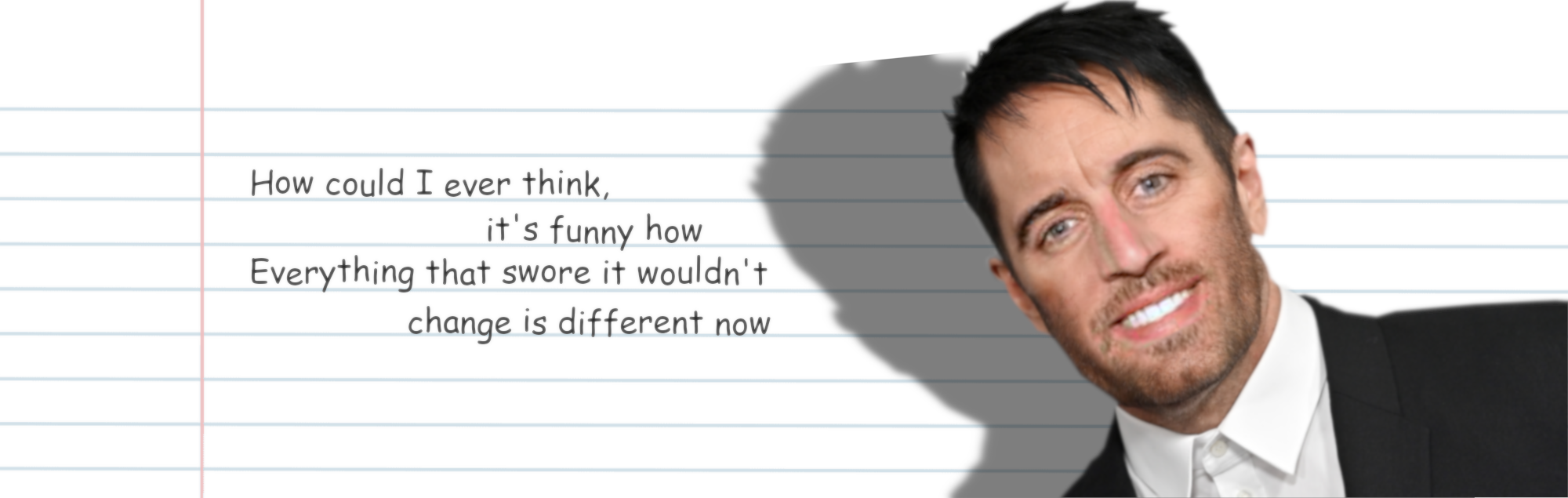
This subtle compositional move connects to the final drive of regulation. At the end of the 4th quarter, Arizona drives the ball down the field, but Neil Rackers misses a 50-yard field goal attempt as time expires. This shatters the illusion of a Packers victory, and Rodgers and Packers fans are reminded that a storybook comeback, one that could establish a narrative of playoff greatness a lá Tom Brady, was not guaranteed. Yet, the score at the end of the fourth quarter was 45-45, meaning the Packers and Rodgers had a chance.
From 3:39-3:56 of “Somewhat Damage’s” runtime, the tension builds as more guitars, synthesizers, and percussion samples are added. The song crescendos at 3:56, with synthesizers sampling Reznor’s voice and double-tracked screams contributing to a sense of unbearable mental torment as Reznor repeats:
After this stanza, many of the instruments drop out, leaving only a few guitars and synths, before the song ends.
The final section of “Somewhat Damage” is strikingly similar to Rodgers’s fortunes in overtime. The Packers won the overtime coin toss, receiving the ball to begin overtime. However, on their second play of the drive, Rodgers was sacked and fumbled the ball. Cardinals linebacker Karlos Dansby returned the fumble 17 yards for a touchdown to win the game. It was a truly shocking final play to the game, one that mirrors the distress Reznor expresses.
The “you” that Reznor is addressing in the final section, as in every Nine Inch Nails song, is open to interpretation and depends on context. It could be an absent parent—Reznor was raised by his grandparents, after all—a former lover, a higher power, or Brett Favre. The fact that Reznor sings “everything that swore it wouldn’t change” suggests that the “you” is nonhuman—if it was, the line would be “everyone who swore they wouldn’t change.” The fact that “it” and “you” are used interchangeably suggests the target of Reznor’s scorn is a higher power of some sort, as God is often personified and referred to as a personified “you” in song lyrics, while “being” a nonhuman, ungendered “it” that does not exist on the same metaphysical plane as us.
When discussing the results of football games, commentators use the phrase “the Football Gods” to describe the overall outcome of games (wins and losses). However, the term “momentum” is used to describe the action that takes during games; an undefinable force that shifts from from play to play, drive to drive. As a result, when interpreted in the context of Rodgers’s first playoff start, Reznor’s lyrics are a spiteful howl at the momentum that shifted suddenly, irrevocably, in the Cardinals’ direction on the final play of the game.
The structure and dynamics of “Somewhat Damaged” closely resembles the events in Rodgers’s first playoff start. From the very first track on the album, the link between The Fragile and Aaron Rodgers’s playoffs career is evident.
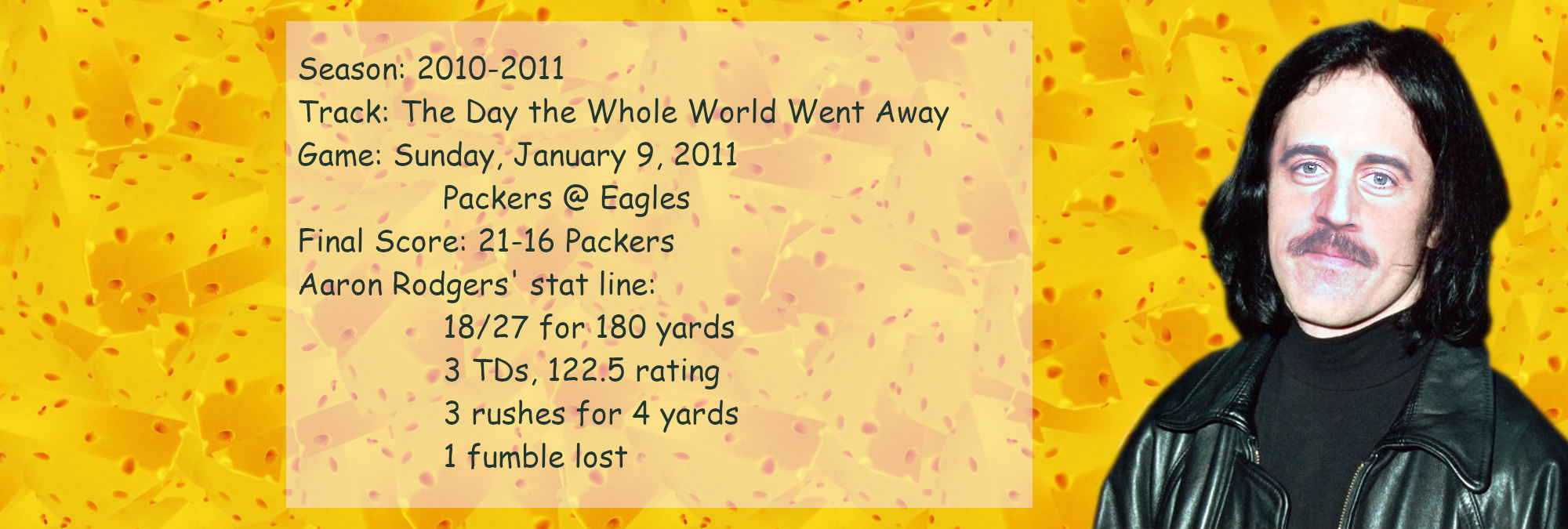
Aaron Rodgers further built upon his legacy in the 2010-2011 playoffs by winning a Super Bowl.
The regular season, on the other hand, was filled with adversity; at midseason, the Packers were a disappointing 5-3, and Rodgers had thrown more interceptions through eight games than he had in his entire first season as a starter. However, Rodgers turned things around in the second half of the regular season, completing over 70% of his passes for 16 touchdowns against two interceptions in the final seven games he played. (He missed one game due to injury.) The Packers snuck into the playoffs as the number six seed, and faced off against the Philadelphia Eagles as slight underdogs.
Going into the game, fans were wondering how Rodgers and the Packers would fare in a road playoff game against the Eagles’ top-three offense. In the regular season, the Packers had tended to collapse under pressure, especially in games decided by less than a touchdown (in which they went 2-6). Additionally, fans were wondering when—or if—Rodgers would truly meet the high expectations set by following in Brett Favre’s footsteps. It was Rodgers’s third full season as a starter, and thus far, the Packers’s regular season success in his career could be attributed to strong defenses; in both 2009 and 2010, the Packers fielded top-five defenses. While Favre also benefited from playing with a strong defense on the other side of the ball early in his career, in his third full season as a starter, he won MVP and brought the Packers to the NFC Championship game. Given that Rodgers was clearly not going to win MVP—the honor would go to Tom Brady that year—anything short of an NFC Championship Game appearance would be seen as a failure.
Needless to say, expectations were high for Rodgers’s second playoff start. “The Day the World Went Away” (hereafter, “TDTWWA”) held a similar place in NIN’s career. “TDTWWA” was released as the first single off of The Fragile, an album that dropped 5 years after its predecessor, the quadruple-platinum The Downward Spiral. The Downward Spiral was NIN’s second full-length release on Interscope Records, and became one of the more influential (and controversial) rock albums of the 1990s. The album’s production was loud, with meticulously-layered and heavily distorted synthesizers with screamed (often clipping) vocals. The album’s lyrics, filled with references to self-loathing, misanthropy, disgust in organized religion, and BDSM-influenced sexual content, outline a loose “concept” about a protagonist who rebels against society before committing suicide.
The album’s bleak aesthetics, coupled with the fact that the album was recorded in same house members of Charles Manson’s cult murdered Sharon Tate and seven other people (including Tate’s unborn child), make it a cipher for what “anti-establishment” hard rock music had become at the time. Most of grunge bands that skyrocketed from playing tiny punk clubs to selling millions of albums in the late 1980s/early 1990s had an adversarial relationship with the music industry and personal fame; bands like Pearl Jam would openly critique or rebel against standard industry practices, while members of other bands were known to engage in unsustainable drug use (including NIN). The Downward Spiral was released in March of 1994; a month later, Kurt Cobain committed suicide. Kurt Cobain’s tragic death, and the addictions that many of his peers battled publicly, painted a grim picture of the state of rock music in the mid 1990s: when an artist’s work is subsumed by the machine they swore to fight against, oftentimes some form of self-destruction is an unfortunate next step (although it does not have to be this way). The Downward Spiral captured this feeling of nihilism and hopelessness…and sold millions of copies as a result.
In the five years between The Downward Spiral and The Fragile, the spirit of most “anti-establishment” hard rock music shifted from the vaguely (sometimes openly) anti-capitalist critique of the early 1990s scene, to a cheaper, more infantile “don’t tell me what to do mom and dad” form of rebellion. (Rage Against the Machine is of course an exception to this.) Bands like Soundgarden and Nirvana were replaced by rap-rock like Korn and Limp Bizkit, bands with lyrics full of outward-facing aggression, overt sexism and homophobia; as on-the-nose as it is, Limp Bizkit even released a song called “Break Stuff.” “Post-grunge” bands like Creed and Nickelback were emerging, providing a more palatable version of the genre with even the slightest hint of systemic critique removed from their aesthetic and lyrics. While there was no expectation that NIN’s The Fragile would bring a meaningful systemic critique—far from it—there was hope that the return of a musical giant from the “previous era” would serve as a respite from an artistically barren mainstream rock landscape.
So, all this to say, the expectations for The Fragile, and its first single “TDTWWA,” were very high, as were the expectations for Rodgers going into his first game of the 2010-2011 playoffs. Both met those expectations, albeit with important caveats. “TDTWWA” reached number 17 on the Billboard Hot 100, despite being one of the many songs on The Fragile that eschews a traditional pop song structure; it has an intro, verse, and outro. While its lyrics are as dark as one would expect from a NIN song, the song is not misanthropic. Far from it, as the most common interpretation of the song lyrics hold that its subject matter is Trent Reznor’s grief over his grandmother’s passing. “TDTWWA” was certainly a “risky” choice as a lead single for a major-label release, but also communicated to fans what to expect over The Fragile’s runtime; a more slow-burning, cinematic version of NIN.
Similarly, Rodgers performed well against the Eagles, throwing three touchdowns with a passer rating of 122.5. But in a game where the Packers got out to a 14-0 lead in the first half, he took on a game-manager role, throwing only 27 passes while rookie James Starks ran for 123 yards (the most rushing yards in a playoff game by a Packers rookie). Like “TDTWWA,” Rodgers’s performance was not the most bombastic or exciting, but fulfilled the needed role and established expectations for the rest of the Packers’s postseason run. As we will see, in the rest of the 2010-2011 postseason, Rodgers was usually not required to put the team on his back. The Packers played classic championship-winning football, relying on their defense and running game to carry them to success. However, Rodgers excelled, for the most part, at preserving leads and making big plays when it mattered to seal victories.
The high expectations for “TDTWWA” ahead of its release as The Fragile’s first single clearly mirrors the expectations of Rodgers’s play in his second playoff start.
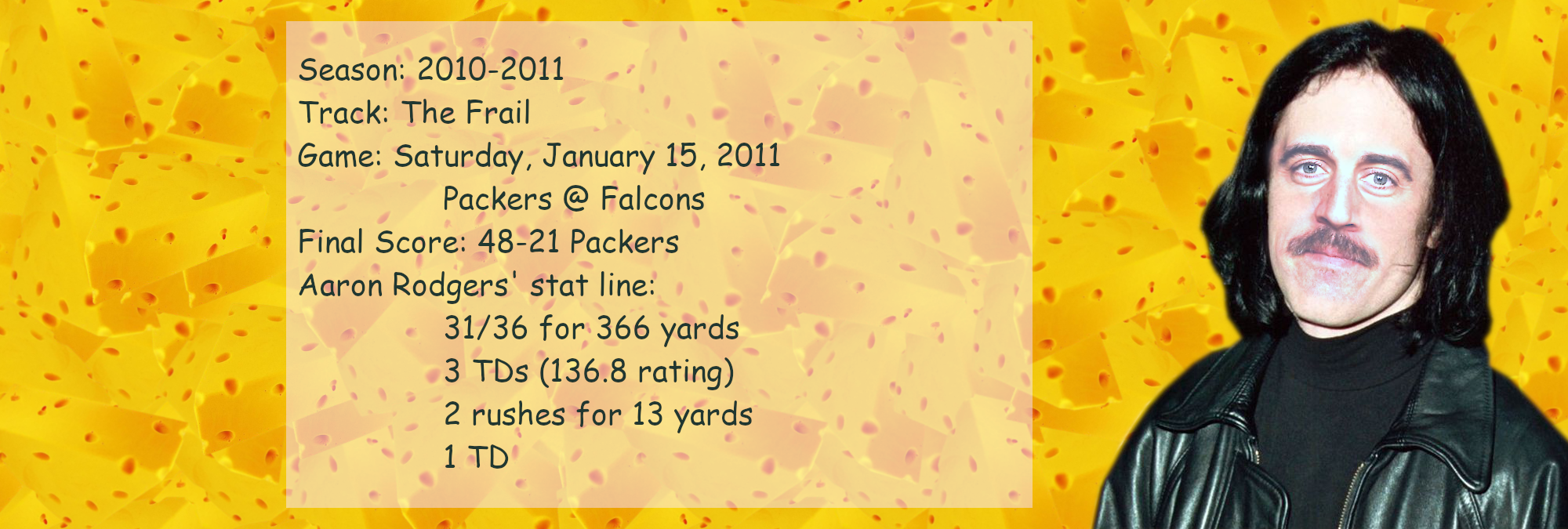
Aaron Rodgers’ game versus the Atlanta Falcons on January 15, 2011, was potentially the best individual performance of his playoff career.
Statistically speaking, he set a career high in completion percentage (86.1%) and passer rating (136.8). He accounted for four total touchdowns and 366 passing yards, which ranked second to his first playoff start (a loss to the Cardinals). While Rodgers did throw for 4 touchdowns and 362 yards in a 2017 wildcard playoff game, his opponent in that game (the 5-seeded New York Giants) was much less formidable than the Atlanta Falcons team he faced in this game. The Falcons were the first seed in the NFC after going 13-3 in the regular season—including a win over the Packers—and came into the came as the betting favorite over the Packers (albeit by a 1.5-point margin).
In short, the Packers demolished the Falcons. The Falcons played it close until the middle of the second quarter, when they held a 14-7 lead, but the Packers scored 35 unanswered points throughout the rest of the second and third quarters, and never relinquished this lead. This allowed the Packers defense to pin their ears back and go after Falcons QB Matt Ryan. The Packers forced Ryan into 2 picks (including one returned 70 yards for a touchdown by CB Tramon Williams). Ryan was sacked five times and lost one fumble, with Defensive Player of the Year runner-up Clay Matthews sacked twice, and 2009 Defensive Player of the Year Charles Woodson getting a sack as well. With this victory, the Packers secured a spot in the NFC Championship Game, getting Rodgers one step closer to his lone Super Bowl win.
The Packers’ victory in this game was about the defense, as well as Rodgers’s exceptional play. It seems illogical to suggest a link between a two-minute instrumental interlude and Rodgers’s best playoff game. However, when one considers “The Frail’s” place in the Fragile’s tracklisting, the connection becomes clear. In short, the Frail provides listeners with the first of the many instrumental tracks on The Fragile. And, while “The Frail” may be one of the more understated of these instrumental tracks, the album’s tracklisting would lose coherence without it. The song serves as a necessary break between the blown-out outro of “The Day the World Went Away” and the album’s bombastic fourth track, “The Wretched.” Similarly, Rodgers’s playoff success was reliant on strong defensive performances. He never established himself as a quarterback who could get a team to a championship with willpower alone. (Yet, then again, outside of Tom Brady, has there ever really been a single quarterback who could do that?) This game illustrates the yin and yang of Rodgers’s playoffs career—Rodgers’s individual passing skills and effective defensive performances—in the same way that “The Frail” introduces listeners to the balance between longer, traditionally structured songs and instrumental pieces on The Fragile.
As an aside, this is a logical place to make this blog series’ first comparison to Pink Floyd’s The Wall. Critics compared the two albums upon The Fragile’s release, 20 years after The Wall. Both were double albums from immensely popular rock groups that dealt with themes of social isolation, extreme mental illness, and drug abuse. Bob Ezrin, who co-produced The Wall, also assisted Trent Reznor in assembling The Fragile’s track listing. Musically, both albums make liberal use of shorter and/or mostly instrumental songs in between more traditionally-structured pop songs. The contrasts between these types of songs gives these albums their “cinematic” scope and feel. In this case, “The Frail” fills a similar role in The Fragile’s track listing as “Another Brick in the Wall, Part 1,” and “The Happiest Days of Our Lives” do in The Wall. The song preceding these shorter pieces (“The Thin Ice”) and the song following them (the radio hit “Another Brick in the Wall, Part 2”) simply would not have the same emotional effect on the listener if they had been presented back-to-back.
From a compositional standpoint, “The Frail” is a looping, harmonically ambiguous piece of music. I am not a music theorist, but my best estimate is that the song is “in G,” as the note appears as a pedal tone in most of the piano chords that drive the song. The chord progression in the first part of the song is particularly interesting. The piano cycles between a Dsus4 (v), Gmin6 without a 3rd (an inverted VI7), Fmin sus4 (vii), before landing on G major (I). The first three chords in the progression hint at a G minor tonality, so resolving the shift from the vii to a G major chord is unexpected, yet still consonant. After the I chord, we return to the Dsus4 (v) chord, followed by Ebmaj7 (VIM7) before unexpectedly shifting to F major (VII). From here, the F major “resolves” to another G major chord, but this time with an added F note, giving our I chord a mixolydian feel. From here, the chord progression cycles back to a Dsus2 (instead of a sus4), before continuing in a similar fashion for a few more repeats.
The outro takes on a more foreboding feel. The piano plays a repeating D-Eb-F-G octave figure. At about 1:06, synth pads (which had been slightly audible in the introduction) resurface. The first synth pad, sampling Reznor’s voice, plays a Bb/A cluster; a second playing a C note enters at 1:25, before shifting to a D note at 1:37. The sustained Bb/A cluster establishes a clear G minor tonality for the section, but the shift from delicately played piano to unnatural-sounding vocal samples makes this section much more tense than the intro of the song. The simple piano part cycling underneath contributes to this sense of unease, plodding underneath as shifting synth textures on top increase tension. The piano drops out with around 10 seconds left in the song, leaving listeners with an uneasy synth texture (Bb/A cluster with a D on top) before the first notes of “The Wretched” enter.
In short, “The Frail” can be described as “beautiful, ambiguous, and tense.” This is how astute Packers fans should feel when reminiscing on Rodgers’s best playoffs performance. Knowing the uneven nature of his playoff career, in the same way that we could expect a chord progression to resolve with perfect consonance in this song, in the same way that we must accept that tenderly played piano notes will be replaced by unstable synths, we could not expect Rodgers to throw for 350+ yards and complete 80+ percent of his passes in every game. And, as we will see, he certainly did not over the course of his career, or even in the 2010-2011 postseason.
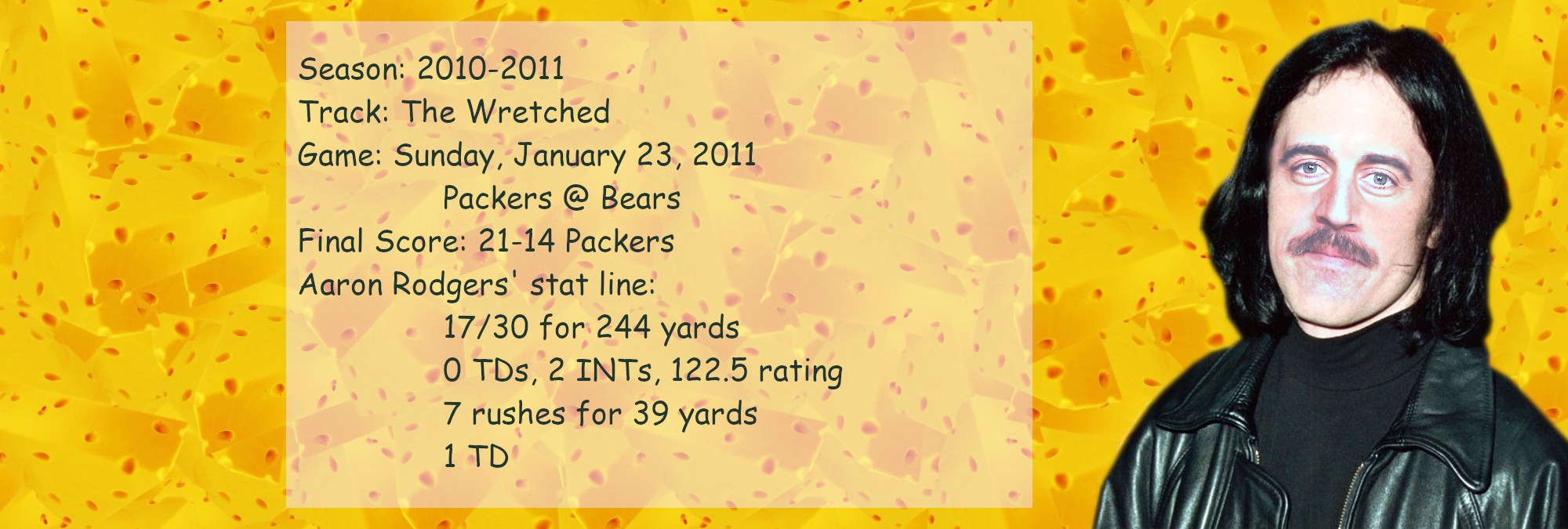
Aaron Rodgers and the Green Bay Packers made it to the NFC Championship Game to face off against their arch-rivals, the Chicago Bears.
This was only the second playoff meeting between the Packers and Bears in the near century-long rivalry. The Packers and Bears split their two 2010 regular season meetings. Tellingly, the Packers snuck by the Bears with a 10-3 victory in week 17, a game the Packers needed to win to secure a playoff berth. While the Bears had already clinched the NFC’s number 2 seed, they still played their starters in a failed attempt to eliminate the Packers from playoff contention. Fans knew this contest was likely going to be close, and defined by the play of each team’s elite defense due to the cold weather; the air temperature at kickoff was 20 degrees, with a wind chill of 7 degrees.
Coming into the contest Rodgers and the Packers were riding high. They were 3.5-point favorites. Rodgers was coming off of a career-best performance and the Packers defense helped stifle the number 1 seed in the NFC, Matt Ryan’s Atlanta Falcons. Going into the game, Rodgers had dispelled any doubt among Packers fans that he was indeed the rightful successor to Brett Favre; but, for the rest of the 2010-2011 playoffs, Rodgers was focused on establishing his own legacy, separate from any comparisons to Favre.
But, as the pre-chorus to “The Wretched” reminds us, “it didn’t turn out the way you wanted it to.” While the Packers got out to a 14-0 lead they never relinquished, they needed cornerback Sam Shields to intercept a pass at the Packers’ 12-yard line to stifle a late Bears comeback effort. It is important to note that the Bears’ starting quarterback Jay Cutler, and their backup, Todd Collins, were both injured in the third quarter. Meaning, Caleb Hanie, the Bears’ third-string quarterback, who had only thrown 14 NFL passes prior to this game, almost knocked the Packers out of a Super Bowl berth.
The fact that this game was close at all was the fault of the Packers’ offense, which sputtered out after scoring two touchdowns in its first two possessions. The offense committed four turnovers, including two Rodgers interceptions. The Bears shut down the Packers’ running game, and stifled Rodgers’s attempts to carry the team with his arm. Of course a team does not want to be passing in the first place when protecting a double-digit lead. However, given that Rodgers completed more than 80% of his passes the previous week, failing to complete even half of his passes when the offense was relying on him in this game meant that some doubt about Rodgers’s playoff-readiness could creep back in. To further illustrate how horrific the Packers’ offense was, you can simply look at the result of the Packers’ final drives. Excluding QB kneeldowns at the end of each half, they were: punt, interception, interception, punt, three-and-out, punt, three-and-out, and another three-and-out.
It is a little on the nose to note that a wretched playoff performance corresponds to a song called “The Wretched,” but here we are. The song’s lyrical themes of extreme self-hatred and pessimism about the present and future echo what Packers fans felt during the second half of this game.
This section of the first verse’s lyrics capture the feelings Packers fans felt while the team established its lead in the first 19 minutes of the game. A feeling of great potential, the idea that the Packers could steamroll the Bears in the same way they had defeated the Falcons the previous week, the hope that every other playoff game this season and over the next decade would be a resounding victory:
Yet, note the use of conditionals in the song’s lyrics: “might have, could have beens.” “The Wretched’s” protagonist knows that he is seeing an illusion (note: I write “he” here intentionally, as the type of rage expressed in Nine Inch Nails songs is very teenage-boy coded). After watching two very close contests with the Bears earlier in the season, Packers fans deep down felt the success of the game’s first few drives were probably not sustainable.
The lyrics in the second verse describe a much more direct, oppressive type of depression and existential dread:
Before commenting on the lyrics themselves, I must note that the second verse of the song begins at 1:48, almost exactly a third of the way into the song. The Packers’ final offensive touchdown of the game came at 11:19 in the second quarter, almost exactly a third of the way into the game. Given that the lyrics align with the offense’s overall performance from that point onward, this cannot be considered a coincidence.
The first lines are a clear subversion of the common “Clouds of Heaven” trope found in Christian art, where God, angels, and/or rays of light appear between parted clouds. Instead of a kind, benevolent God presenting itself to the protagonist, the higher power physically restrains and torments him. At one level, this language serves to shock the audience, but also emphasizes the protagonist’s complete lack of agency in addressing his problems. Trent Reznor was in the depths of drug addiction when writing and recording The Fragile, so the protagonist’s hopelessness reflects Reznor’s own inability to overcome his drug habit at the time. These lines also reflect what Rodgers was likely feeling during the latter part of the game, as he had been given the seemingly impossible task of preserving a lead against a top-ranked defense with no functioning running game.
And, in the long-run, neither Reznor’s nor Rodger’s careers went as they had hoped…but they were both OK in the end. The Fragile was not the commercial smash that The Downward Spiral was, and was Nine Inch Nails’ final platinum album. After the 2010-2011 postseason, Rodgers failed to achieve sustained postseason success. What if Reznor had released 2005’s more succinct and straightforward With Teeth instead of a sprawling, musically challenging double album? Would Nine Inch Nails have potentially reached even greater popularity and influence? Would Reznor’s second act as a Grammy- and Oscar-winning film composer have taken off? And, what if even one of the Packers’ close losses in the 2014-2016 playoffs broke the other way? Would an additional Super Bowl ring put Rodgers in contention with Peyton Manning and Tom Brady for the mantle of G.O.A.T., instead of “just” as a future first-ballot Hall of Famer? As Reznor mentions in “the Wretched,” there are many unrealized might-have-beens and could-have-beens.
To conclude with a note about this specific game: despite a wretched offensive performance, the Packers won the game and proceeded to the Super Bowl.
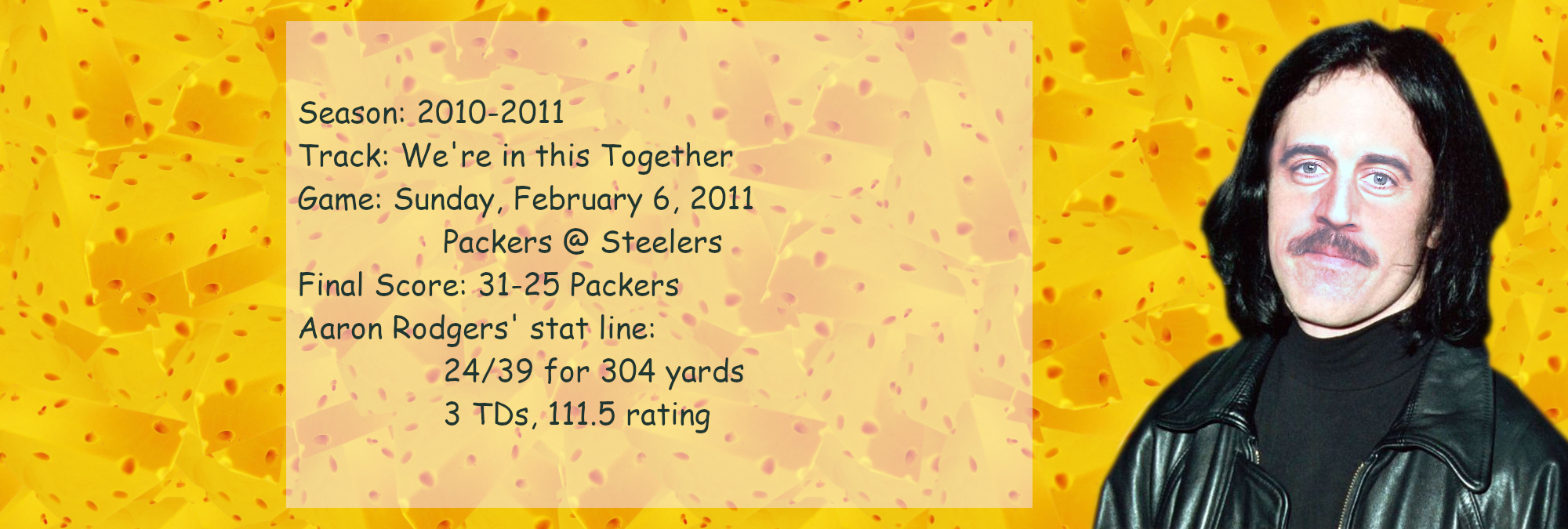
“We’re In This Together” (hereafter “WITT”) was clearly written to be The Fragile’s hit single.
The Packers’ Super Bowl XLV victory was the “hit single” of Aaron Rodgers’ playoff career. Rodgers won the game’s MVP award, and was the first quarterback to throw for over 300 yards and three touchdowns with no interceptions in a Super Bowl. His performance put an exclamation point on the end of the Packers’ championship run, and cemented his place in Packers history. For the entirety of the 2010-2011 playoffs, Rodgers accounted for 11 total touchdowns (nine passing, two rushing) and only three turnovers (two interceptions and a fumble), while putting up a 109.8 passer rating. Rodgers established sky-high expectations for the remainder of his playoff career, which in hindsight were unfulfilled, and perhaps unrealistic in the first place.
“WITT” is also arguably the best individual song on The Fragile. It is structured as a straight-forward pop song, but is bookended with an atmospheric intro and outro; the song stands out from much of the other songs on the album, but serves as an important anchor point in the album’s track listing. Similar to The Wall’s obvious hit single, “Another Brick in the Wall, Part 2,” “WITT” sits in the middle of the album’s first disc and is preceded by more dissonant, less-straight forward songs. Additionally, both “Another Brick” and “WITT” are followed in the track listing by relatively more restrained pop songs that are crucial for establishing each album’s main lyrical themes (“Mother” and “The Fragile,” respectively).
Plucked strings from “The Wretched” carry over into the introduction of “WITT,” and are gradually drowned out by foreboding synthesizers. At 0:36, Trent Reznor’s screaming voice fades in as distorted guitars and a plodding drum beat carry the listener through the second half of the intro. Interestingly enough, if you play “WITT” over the National Football League’s official highlight reel from the game (“Super Bowl XLV: Steelers vs. Packers highlights”), Reznor’s screaming leads directly lines up with Rodgers’s first throw. The fact that strings from “The Wretched” are audible in the first part of “WITT” is also relevant, because like in the NFC Championship Game, the Packers’ offense was not able to move the ball effectively during its first two possessions. However, Rodgers threw a touchdown on the Packers’ third possession, and on the first play of the next drive, Steelers’ quarterback Ben Roethlisberger threw a pick-six to Packers safety Nick Collins. (Collins’s celebration in the aforementioned highlight video also coincides with the beginning of “”WITT’s” first verse at 1:14.)
“WITT’s” verses are melodic, yet tense. Reznor’s vocal delivery is strained, conveying the desperate, codependent nature of the relationship depicted in the lyrics:
The song’s choruses, by contrast, are anthemic. Reznor’s vocal delivery is more controlled and stable, despite being shouted. Tambourine and guitars cycling through a simple D-minor chord progression consistent eighth-note triads give the section a more danceable and driving rhythmic feel. Reznor sings:
These lyrics read as a more optimistic, positive view on the relationship Reznor is describing. It also reflects that Rodgers’s performance in Super Bowl XLV established him as the Packers’ franchise quarterback for the next decade—a relationship between a player and a team that pundits often compare to romantic relationships. The chorus creates a feeling of inevitable triumph or certainty—something Reznor may have felt in this relationship, and which Rodgers and the Packers hoped to have going forward.
However, the chorus’s lyrics have a different, darker meaning when interpreted in the broader context of the entire piece. The second verse’s lyrics further emphasize that the song’s subject is a codependent relationship:
The idea of being in a relationship like this “until the very end of me, until the very end of you,” while Reznor is comparing the relationship to a wound, does not seem to be the best long-term decision for either party. Similarly, while Rodgers expressed a desire to spend his entire career playing for Green Bay, we see that the relationship between Rodgers and the Packers did inevitably sour. Just like how unrealistic expectations for both partners are established in codependent relationships, Rodgers’ relationship with the Packers soured because, for a time, he could not live up to the standards he had established early on in his career. The Packers drafted Jordan Love as a result, and just as the Packers’ illusions of Rodgers were shattered, Rodgers’ illusions of the franchise he played for were shattered.
With 2:24 left in the first half, the Packers had established a 21-3 lead over the Steelers. However, like in the NFC Championship Game, the Packers spent the rest of the contest trying to outlast their opponent’s comeback effort. This was especially true in the third quarter, where the Steelers cut their deficit to less than a touchdown. This dynamic is clearly captured in the break after “WITT’s” second chorus, where Reznor repeats “all that we were is gone, we have to hold on.”
“WITT’s” final chorus includes additional guitars, but the most important difference between it and the previous two choruses is the variation in the lyrics in the final repetition:
The sense of triumph over adversity in these lyrics emphasizes the adversity the Packers experienced in Super Bowl XLV. The Packers lost important veterans Donald Driver and Charles Woodson to injury in the game, along with starting cornerback Sam Shields, during the game. Yet, even after everything, Rodgers and the Packers won their first and only Super Bowl. In the NFL, nothing else means anything.