Research Report 2025
To outside onlookers, 2025 might have seemed like a relatively quiet year for GoatVision Labs. However, our dedicated research team of aural alchemists have been working hard to exceed the limits of current understanding and usher in a new era of eclectic experimentation. An ethos of experimentation is characterized by a constant questioning of our surroundings and assumptions. While mainstream or traditional research methods may rely heavily on current understanding, building upon it slowly and methodically, the mad scientists of GoatVision Labs are undaunted at the prospect of deciphering anomalies head on. We unflinchingly confront the auditory anomalies of our time, employing unusual and varied methodologies in an attempt to unravel them for our audience. In this article, four of our core members will detail their research processes from the past year to provide a kaleidoscopic glimpse into the ways their disparate approaches contribute to the array of projects in our catalogue.
moth_OS: the Development of moss I/O
- Will Patton
In 2025, moth_OS released its second EP, moss I/O. My bandmate, Liam, and I had been working on this EP since the band’s first rehearsal in 2020 and intended to release it as a quick followup to the band’s first EP, mothware. Even despite some serious health setbacks starting in mid-2021, we continued to make slow, steady progress on the four songs for the next 18 months or so. Unfortunately, by late 2022, some serious personal circumstances, as well as obligations surrounding the completion and release of The Goat Wizard’s Mobile Government Sitcom, made it prohibitively difficult for us to continue working together on the project. Progress on the nearly-complete recordings stalled out around this time, and very little progress was made for most of 2023; without the crucial feedback and constant evolution of ideas that comes from close collaboration, it became very difficult to complete the project.
In October 2023, nine months after my father, Liam passed away. Obviously this greatly exacerbated the struggle to complete our recordings. The morbid lyrics, which had already been completed by this time, took on a bizarre, almost prophetic weight. Liam’s call-and-response verses with an otherworldly digital being on “nCryptid” became particularly haunting. The immense mournful energy undergirding the entire project compounded with the previously mentioned issues of working in isolation, making our EP seemingly impossible to finish. But to leave it unfinished would have been disrespectful to Liam’s memory.
Liam McCarty wearing Mariya Takeuchi
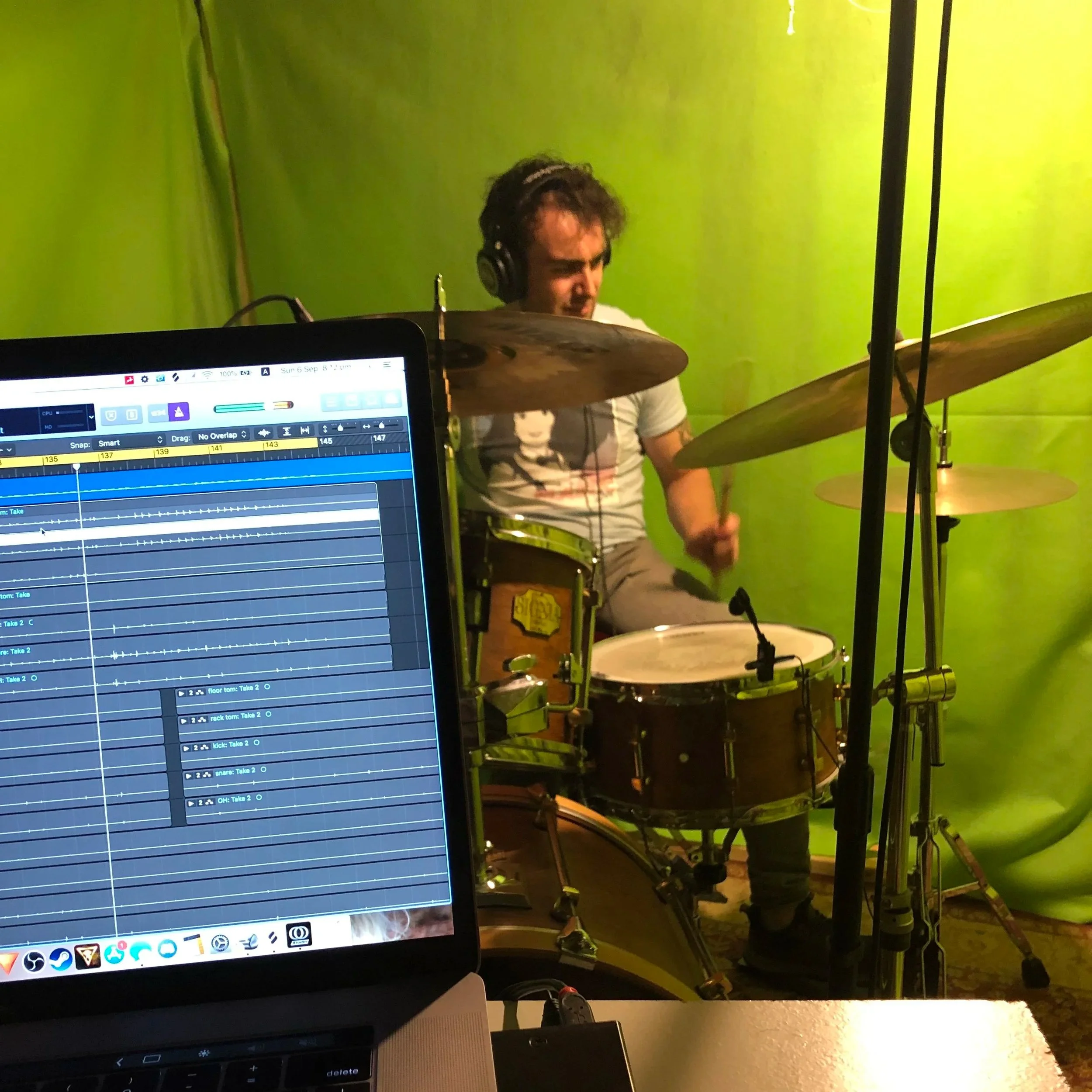
It’s only thanks to the contributions of friends of mine, and of Liam, that moss I/O could be completed and released this year. Our great friend, Luis, worked incredibly hard to contribute drum performances to the EP based on the midi demos Liam and I created. Another friend, Dom Ellis, who was very important to Liam, provided a fantastic bass track for “memory bomb” to create a flavour reminiscent of the Taeko Onuki records that were so foundational to the sound Liam and I were trying to create with moth_OS. Other essential contributions by Alex Kurki and Jared Pitonak also helped motivate me to finish the EP to the best of my abilities. Ultimately, I think we were able to create something that would have lived up to Liam’s expectations.
In preparing to write my part for this piece, I had almost forgotten that the EP came out this year, because it chronicles so specifically the particular time in our lives in which it was written. Musically, I was focusing heavily on harmony at the time by trying to create colourful, yet purposeful, chord progressions that could potentially surprise more eclectic listeners while also engaging a broader audience. In 2025 however, I moved forward; my focus lately has been on exploring the spaces between the now-familiar notes and rhythms that I’ve learned to take for granted. Are there rhythms that evade exact quantification through traditional western means? Are there ways to augment typical functional harmony and chord progressions using unusually granular voice leading, intervals, etc.? These are the questions I am currently investigating. The first part of my findings was released as moth_OS’ 2024 single nite shift. The song is set to be the first track on a five-song EP presenting my preliminary findings on this matter, and which will release sometime next year.
Aimless Listening
- Luis Gonzalez
Over the past year, my tastes have been more contradictory than ever. I’ve been listening to many different kinds of music, and I’ve been listening to music in different ways too.
As far as how I usually listened to music over the past year, I’d pick an album and take my time to appreciate it, track by track. When I first listened to an album, I tended to hyper-fixate on a track or two. Then, after I grew accustomed to the artist’s sound, I would fill in the gaps by enjoying the rest of the album.
More recently, however, I have been drifting between many different albums, listening to them all the way through in a less systematic manner. This is not to say that the albums I’ve been listening to haven’t caught my attention, but maybe my focus has been wack recently. Sometimes I wonder, has the doom scrolling ruined me? Probably not, I’m just being dramatic (hopefully).
This new approach has given me a new perspective on music. Listening to the whole album lets me stop hyperfixing on specific moments and cool parts in songs. I'm turning my attention to the vibe of the entire album. For the next 30 to 45 minutes, I am giving myself to this artistic statement. I want to breathe in the experience. Close my eyes and hear the universe that is sonically created. Even if the album is not cohesive, trying to find the connecting strains and ideas makes me feel like I am in a detective show, pinning red strings between documents on a board. Call me crazy, but let me fucking cook!
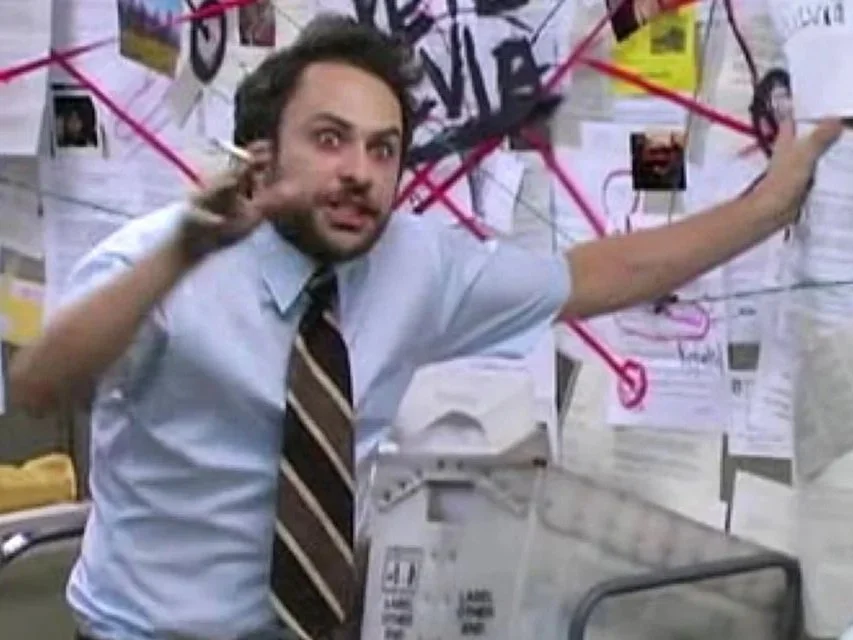
Luis attempting to decipher the new Tame Impala record
For example, consider Tyler the Creator's new album Don’t Tap The Glass. The album’s mission statement is, “put down that stupid phone, get up, and move your body to this.” And that’s what I was doing while listening. I would toss my phone in another room, get off my couch, and groove along to the album. It felt like going to a concert of a band you knew playing a new song. I kept thinking, “Alright, I don’t know if I’m going to love it but I appreciate you and will give it a chance.” And I did. It was a fun album! It also made me realize I dance so awkwardly. (As Will Ferrell’s character asked in Talladega Nights, “what do I do with my hands?”)
The albums I have been consistently listening to have had amazing connecting threads and vibes that let me get lost in my mind for 40-ish minutes. I want to shout out to I Love My Computer by Ninajirachi. Will put me on to this album and I am so happy he did! It’s just banger after banger. Instant rave. CHAINSAW MAN THE MOVIE: REZE ARC Original Soundtrack - summer’s end by Kensuke Ushio is absolutely sick. Any album with the majority of its track titles written in lowercase letters has to be dope. There are zany, fun tracks like “from below with love,” “silly walk,” and “stroke of genius” that keep the album upbeat. They’re contrasted with more gentle, intimate tracks like “day dream,” “in the pool,” and “Reze,” which make you forget the movie is so pervy. But, I swear I watched the movie for the “plot.” All jokes aside, it’s an incredibly inspiring soundtrack to get lost in.
Constant Government Shitcom
- Greyson Sztuczko
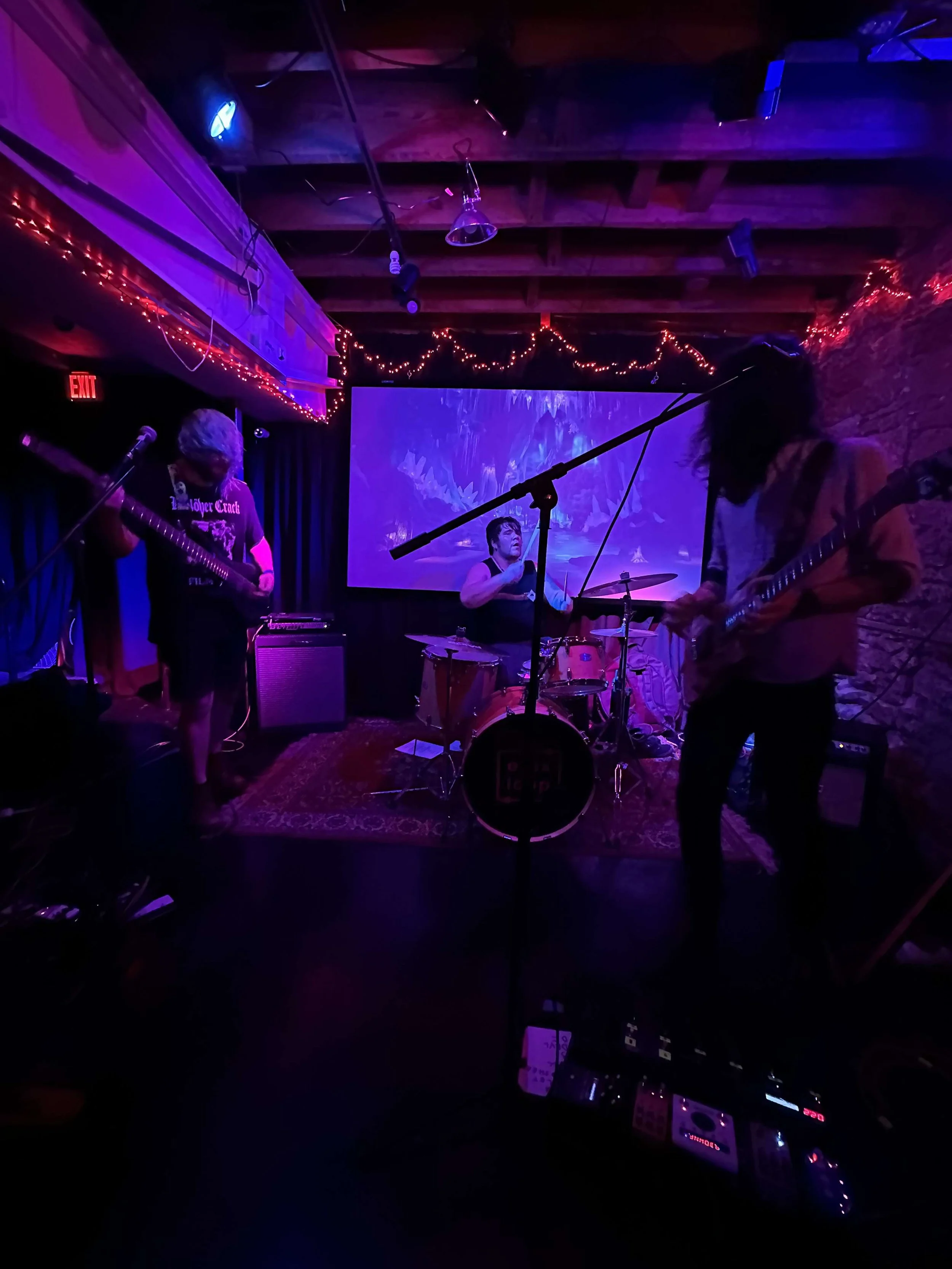
I’ve been working on a lot of music this year! Hard rock with Trajectoids, jazz with my wife in Some Other Fool, covers through my teaching at Madison Music Foundry, secret laboratory projects with some Goats (!!!) and setting up a new music space for myself. While I have been enjoying these endeavors immensely, I have also been thinking: playing music in 2025 is not easy! The big-picture state of the music industry feels bleak. To be clear, I think there’s more amazing music than ever, but that feeling stems from the business practices of the corporations that have the most influence over the industry.
Trajectoids
Live Nation Entertainment (the company that owns Ticketmaster and Live Nation) controls the vast majority of U.S. concert ticket sales. With great power comes great responsibility, and with that power, Live Nation Entertainment is responsible for making the live event experience worse for everyone. They use their control of the market to bully artists and venues into forking over even more revenue to them. They use their control of the market to raise ticket prices for concertgoers. But they do not just raise ticket prices across the board, but through “dynamic pricing,” where tickets that are more “in demand” rise in price accordingly. (This is an issue that entered the public consciousness due to the dedication of radicalized Swifties, and I thank them for their work.) Back in the day, part of the appeal of Ticketmaster was that it cut ticket scalpers out of the resale ticket market. But, in 2025, Live Nation Entertainment gives them a warm embrace and has effectively become the world’s largest ticket scalper. Live Nation Entertainment takes the promises of the live music experience – which is at minimum fun and communal, and in ideal cases, ecstatic and enlightening – and flattens it into a revenue grift, nothing more.
Spotify also blows. The company holds a plurality of the world’s music streaming market share (32%), more than twice as much as its closest competitors. Streaming is the main way people listen to music today, so artists who want to be heard have few options but to play the game, despite getting $0.005 per stream, maximum. Artists with fewer than 1,000 streams a year receive no royalties. The company’s model is bad for big and small artists alike. And, what does Spotify’s CEO Daniel Ek do with the money he siphons off of the creative work of others? Invests hundreds of millions of dollars into AI military technology. To top it off, the platform has seen a flood of AI-created music that rips off human artists (which artists must consent to in the terms of service). Even successful artists like King Gizzard and the Lizard Wizard leaving the platform only prompted AI slop to try and fill the void they left. It makes me fearful that if I saw enough success on the platform, it would get drowned out by robots competing to replicate my hard work. This sounds like a cool 80’s sci-fi film premise, but makes for concerning career prospects.
As an independent artist, this puts me in a situation which irks my conscience, to say the least. There is no financial return to posting music on streaming services. And at the same time, online fans in general seem disinterested in engaging with or supporting musicians they like in a tangible way. As an artist, the connection I have with online fans feels as ephemeral as their listening experience on Spotify is – my music might show up in an AI-generated playlist, they might hit the “love” button, and as a result my music might show up in another one of their AI-generated playlists in the future.
I also have been thinking about the fact that some mid-sized bands, like Garbage, will stop touring nationally. The band’s frontwoman, Shirley Manson, says they “have decided that the economics have become untenable.” It makes me start to reconsider, and maybe redefine, what a successful music career could look like.
However, there are spots of light in all this. Playing shows for real people in intimate, local spaces is still great. If Live Nation Entertainment commodifies the experience, local shows and locally-run venues still present a genuine alternative. Every local show I played this year (in different groups) felt positive, connection-building, and was entertaining for the audience. Seeing disparate people show up, and lean back and close their eyes to some jazz-folk during Make Music Madison, or bounce up and down to some heavy riffs in a bar basement, brings me joy. At a time when the government is building the swamp and sucking eggs, when corporations threaten to supplant hard-working and thoughtful artists (and art-consumers!), art and community are more important than ever, and we are not going anywhere.
We live in a time where change is inevitable, and it feels like the changes coming are huge and not necessarily all positive. But, I remain steadfast and hopeful that we can look out for each other and nurture a better society. We will make the most of it. And we will make great art. Art will always be the door to understanding ourselves and ensuring that mentality is reflected in reality. Preserve community spaces and experiences that help us to thrive in spite of the uncertainty. Find reasons to connect with others instead of disengaging. Don’t buy stuff you don’t need from companies that want to wring us dry. Hang 10, good buddy.
Panduri Fury
- Alex Kurki
In April 2024–literally hours after sending off the mastered bonus tracks for the Progressive Polka Project’s path-breaking masterpiece, Polka, Pizzazz, and Polkas, I boarded a flight to the country of Georgia (in Georgian, “Sakartvelo”). Since then, I have been living in a village in a rural part of the country. When I departed, I did not know what my exact living situation for the next two years would be (in other words, how often or if I would have regular access to electricity and running water) so I left behind my electric guitar and pedalboard. Instead, I brought along an acoustic guitar.
By the beginning of 2025, I had largely acclimated to my new lifestyle in Georgia. But, I have still been adjusting to the musical paradigm shift I have been thrust into. The term “paradigm shift” comes from Thomas Kuhn’s work The Structure of Scientific Revolutions. Before a paradigm shift, practitioners operate in “normal science,” or a physical, technical, and intellectual comfort zone. Progress occurs within the accepted limits of the status quo. A “paradigm shift” happens when the prior intellectual and technical axioms are challenged and eventually discarded for something new. I have never been a big fan of the acoustic guitar. Due to personal preference (and a bit of laziness in regards to consistent practice) I have been drawn to the electric guitar; the expressive potential of different effect pedals, a desire to find the most off-the-wall, disgusting tonalities I can. My musical outlook is more influenced by Converge and Swans than by Tommy Emmanuel and Gordan Lightfoot. Yet, now I have had to learn to fingerpick, and maybe sing a little, to play music in my new environment. My acoustic playing sounded unnatural to me at first, A year and a half later, it still does. My sonic experiments have been outside of my “normal” framework. Yet, I have been learning new playing techniques to fit the acoustic guitar specifically. And I have been doing what I can to glean additional musical insights from my environment.
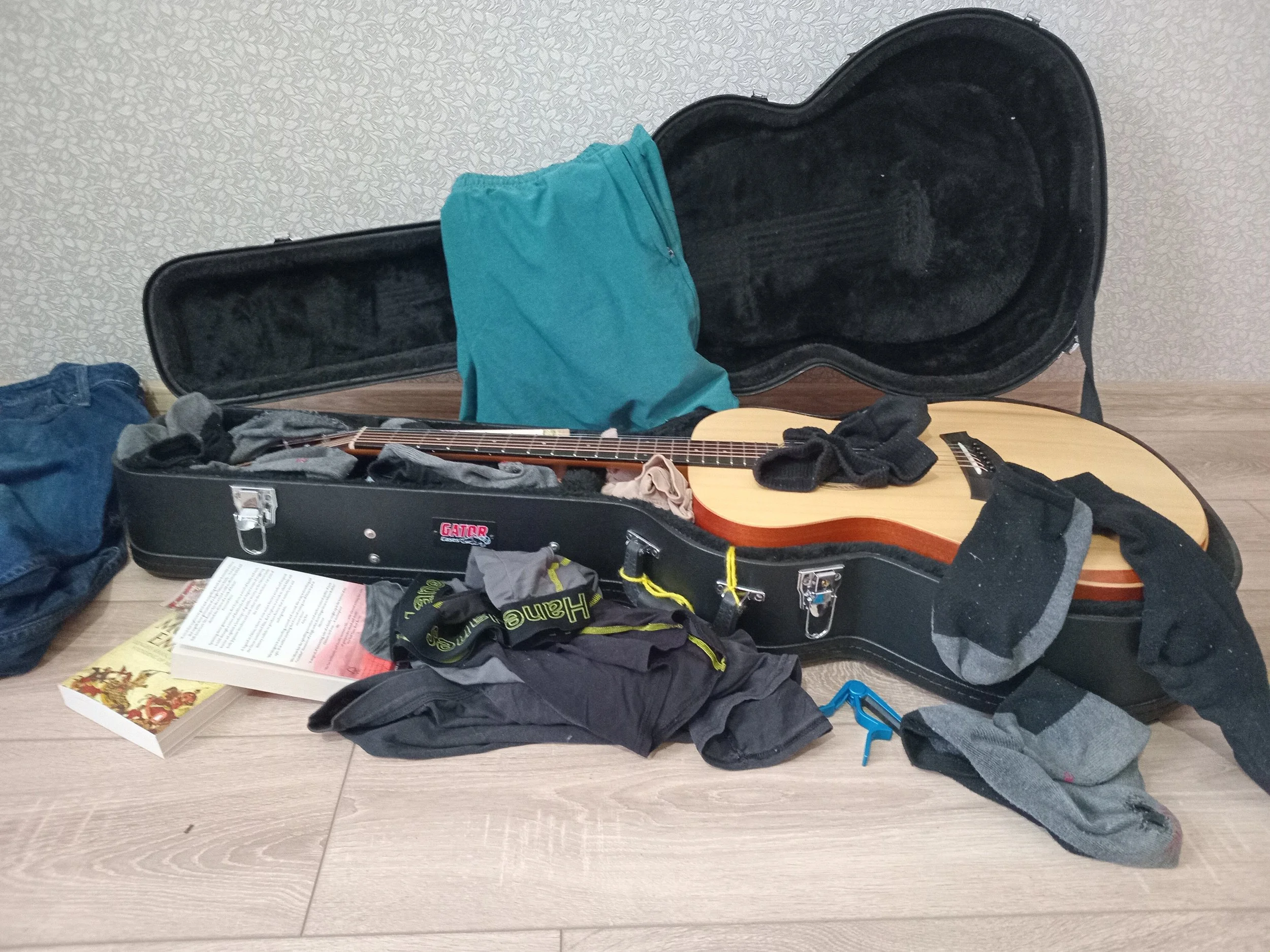
Reenactment of the Journey to Georgia
The first musical-scientific question that I have been trying to answer is: “can I learn to play and understand Georgian music?” The answer is, “kind of.” I have been learning to play the panduri–a fretted, three-stringed instrument popular in traditional Georgian music. I sit in on the panduri lessons my organization offers. Hilariously, these lessons are for local youth, so I am almost three times the age of most of the students in the class. We always tune by ear, there is no metronome in sight–something unheard of for someone like me, a perfectionist who plays in a progressive rock band. Some students have brand new panduris, some have literally taped-together, extremely battered instruments. Despite these limitations, the kids play in time, singing confidently and in tune.
Georgian folk songs are relatively easy to play and sing with one vocal part. However, once the teacher introduces the polyphonic harmonies–depending on the song, there can be as many as five vocal parts–I have to give up on singing and focus on the rhythm of my panduri playing. I cannot participate. It does not come naturally to me, as it seems to for the Georgians. Polyphonic singing is their UNESCO-recognized piece of “Intangible Cultural Heritage of Humanity,” not mine. I merely record music for the Progressive Polka Project–culturally important, of course, but not yet recognized as such by UNESCO. Still, I have developed a repertoire of about 10 Georgian folk songs that I can hack my way through.
As a paradigm shift occurs, new scientific questions come to light. The boundaries of what is or is not a “scientific” question shift. This year, I found myself confronting another, more unexpected musical-scientific question: “can I really record a seven-person choir on a broken mixer and one microphone, with one take per song?” You can see the output of that experiment here. This recording captures a local vocal ensemble performing with two nationally-known guests born and raised in the village I live in. The recording conditions were not ideal, but the raw talent of the performers is evident. (Also, a big thanks to Will for helping me clean up the audio). And, if I had not been present, the recording would not have happened at all.
This exploratory experiment led me to another musical-scientific question: “whose music is recorded, and for what purpose?” UNESCO notes that Georgian polyphony is an endangered piece of cultural heritage, “threatened by rural exodus as well as by the increasing success of pop music.” The village I live in is rapidly shrinking, full of houses abandoned as younger people move to the capital city or to other countries for better economic opportunities. Yet, my village is still full of talented musicians who sing traditional Georgian songs. Few of them would be considered “professionals.” But their voices bring joy and cultural life to their community in a way that the atomized consumption and production of popular music (“Western” and otherwise) does not. The importance and beauty of this style of music cannot be truly understood unless you hear it in person–it has literally brought me to tears. What is more, these musicians, like the vast majority of musicians, are not “professional” or “famous.” And, over the course of human history, the vast majority of music has not been recorded. It is sound waves that dissipate until only silence remains.
Trying to grapple with and provide a satisfactory answer to these musical-scientific questions in a clear, concise manner is not possible. Yet, throughout 2025 I have been writing songs on acoustic guitar in a futile attempt to do just that. The pieces I write do not sound like the songs I study on panduri, or even guitar, for that matter. What comes out when I write are not consonant, cascading finger-picked arpeggios influenced by Georgian polyphony. Or even the somewhat off-the-wall compositions of fingerstyle guitar virtuoso Hayden Pedigo (who, by the way, collaborated with noise rock group Chat Pile on one of the best albums of 2025, In the Earth Again). Rather, my compositions feel like the speech of someone with basic-conversational knowledge of a language: angular, halting, with occasional moments of clarity and beauty, only somewhat comprehensible.
The results of this exploratory experiment will be released as an EP in 2026. While it is not the kind of music I saw myself writing, I am writing it. Thinking back to when I recorded the choir on malfunctioning equipment, and how some of my fellow students study panduri on broken instruments…people will always find a way to express themselves despite the limitations they face.
I will be returning to the United States in 2026. We will need to see if this experience leads to a true musical paradigm shift for me, or if I return to “normal science” once I have access to my usual songwriting tools. Either way, I am enjoying working in my current situation.